Summary:
Most facility managers don’t think about tank insulation until something goes wrong — energy bills climb, product quality slips, or a compliance audit surfaces a gap they weren’t expecting. By then, the damage is already underway.
Understanding how a tank insulation system is actually designed — not just what it looks like on the outside — puts you in a much better position to make the right call before problems compound. Whether you’re evaluating a new installation, a retrofit, or trying to understand why your current system isn’t performing, this guide walks through the components that matter, the materials worth knowing, and the questions worth asking before any contractor sets foot on your site.
Understanding Tank Insulation Systems: Design Principles and Core Components
A tank insulation system isn’t a single product — it’s an engineered assembly. The outer sheathing, the insulation core, the vapor barrier, the panel joinery, and the roofing system all work together. When any one of those components is undersized, mismatched, or improperly installed, the whole system suffers.
The starting point for any good design is the operating temperature. A tank holding water for fire suppression at 50°F has completely different requirements than one storing asphalt at 400°F or liquid ammonia at -50°F. From that temperature requirement, we can work backward to determine the right insulation material, the necessary thickness, the appropriate vapor barrier, and the sheathing that will hold up over time.
What most people don’t realize is how much thermal expansion and contraction affects a tank system. Metal expands in summer heat and contracts in winter cold. A system that doesn’t account for that movement — through flexible panel assemblies and properly engineered roofing — will develop gaps, stress fractures, and moisture entry points within a few years.
What Does a Tank Sidewall Insulation System Actually Include?
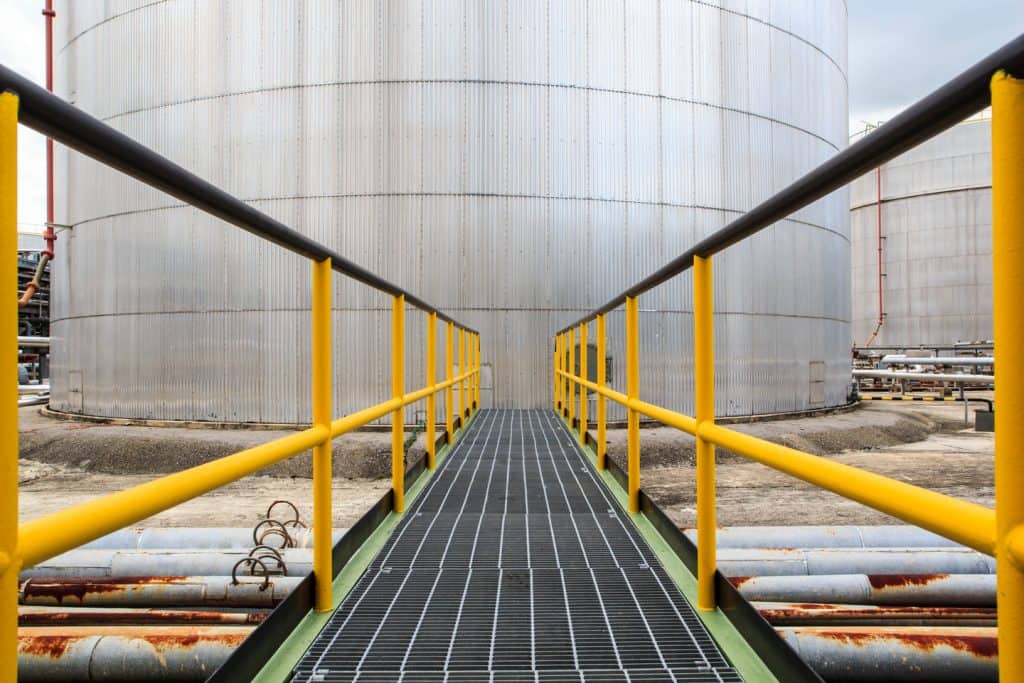
The sidewall is where most of the thermal work happens, and it’s also where most installation errors occur. A properly engineered sidewall system uses panels that are factory-curved to match the exact radius of your tank. This matters more than it sounds. When flat panels are forced to conform to a curved surface, you get gaps — and gaps mean thermal bridging, moisture infiltration, and eventually corrosion under the insulation.
The panel itself is typically a sandwich assembly: a metal sheathing layer on the outside, an insulation core in the middle, and a vapor barrier layer on the inside. The sheathing protects against weather, UV, and mechanical damage. In coastal Nassau County, where salt air off the Atlantic and Long Island Sound accelerates corrosion, the sheathing material isn’t a minor detail — it’s a long-term durability decision. Stainless steel, galvalume, and coated aluminum all offer different trade-offs in cost, weight, and corrosion resistance.
The insulation core is where the thermal performance lives. Foil-faced polyisocyanurate (PIR) foam is one of the most effective options available — it delivers high R-value per inch, resists moisture absorption, and holds its thermal performance over time. Fiberglass, mineral wool, perlite, and foam glass are also used depending on the application, each with its own strengths and limitations.
Then there’s how the panels are attached. Welded attachment systems require the tank to be taken offline during installation — which can mean days or weeks of lost production. Systems that use a tensioned band assembly instead of welded anchors allow the tank to stay fully operational throughout the entire installation process. For a wastewater treatment facility or a fuel storage operation in Nassau County, that distinction can translate directly into avoided costs.
Finally, the panel joinery — how sections connect at seams and transitions — determines how well the system handles both thermal movement and moisture. Poorly sealed seams are the most common entry point for water, and once moisture gets behind the sheathing, corrosion under insulation (CUI) begins. CUI is one of the leading causes of premature tank system failure, and it’s almost entirely preventable with the right design.
Why Tank Roofing Systems Are Engineered Separately — and Why It Matters
The roof of a storage tank is not a building roof. That distinction sounds obvious, but it’s routinely ignored by contractors who repurpose standard building roofing materials for tank applications. The result is systems that look fine on day one and start failing within a few years.
A properly designed tank roofing system is engineered to move independently of the tank itself. As the tank expands and contracts with temperature changes, the roof needs to accommodate that movement without cracking seams or pulling away from the sidewall connection. A system that’s rigidly attached will fight the tank’s natural movement — and the tank will win.
Wind load is the other major engineering variable. Nassau County’s coastal geography makes this a real-world concern, not a theoretical one. Nor’easters push sustained high winds across Long Island regularly, and tropical weather events can bring gusts that exceed what most standard systems are designed for. A roofing system rated for wind speeds up to 150 mph isn’t overengineering for this market — it’s appropriate engineering for this climate.
The roof also needs to be fully walkable for maintenance access. Inspection protocols for industrial tanks require periodic visual checks of the roofing surface, penetrations, and edge connections. A system that isn’t designed for foot traffic creates a situation where maintenance teams either skip inspections or create damage trying to perform them. Neither outcome is acceptable on a tank that’s holding fire suppression water for a Nassau County municipality or a temperature-sensitive product for a food processing facility.
The takeaway is that roofing and sidewall systems need to be designed as a coordinated assembly — not sourced separately and hoped to work together. When both are engineered by the same team, with the same understanding of the tank’s operating conditions, the result is a system that performs consistently over its full service life.
Insulation Material for Water Tanks and Industrial Applications: How to Compare Your Options
Material selection is one of the most consequential decisions in a tank insulation project, and it’s also one of the most frequently oversimplified. The right material depends on your operating temperature, the tank contents, the ambient environment, and the long-term maintenance expectations for your facility.
For water storage tanks — including fire protection tanks subject to NFPA 22 requirements — the insulation needs to maintain water above 42°F through a Nassau County winter, handle repeated freeze-thaw cycles without degrading, and resist moisture infiltration in an outdoor environment. Those requirements point toward closed-cell foam systems with robust vapor barriers, not open-cell or fibrous materials that absorb moisture over time.
For industrial applications at higher temperatures, the calculus shifts. Asphalt storage, petrochemical processing, and thermal energy storage each have different thermal performance targets and material compatibility requirements. The point is that no single material is right for every application — and a contractor who recommends the same solution regardless of your specific situation isn’t doing the engineering work your project requires.
How to Choose the Right Tank Insulation Contractor for Your Nassau County Facility
The most important thing to understand about hiring a tank insulation contractor is that industrial tank insulation is a specialty — not a subset of general insulation work. A contractor who installs spray foam in residential attics or wraps commercial HVAC ductwork has not done the engineering work that a storage tank project requires. The curved surfaces, the thermal expansion calculations, the vapor barrier design, the wind load analysis — these are not skills that transfer automatically from building insulation.
When evaluating contractors, the first question is straightforward: how many industrial storage tanks have you actually worked on, and in what industries? Experience with fire protection water storage tanks, wastewater digesters, petrochemical tanks, and cold storage applications are all meaningfully different. A contractor with 40 years of focused experience in tank insulation systems has navigated a range of configurations, regulatory environments, and material challenges that a general insulation firm simply hasn’t encountered.
Compliance documentation matters too. For fire protection water storage tanks in Nassau County, NFPA 22 compliance isn’t optional — it’s a requirement enforced by the Nassau County Fire Prevention Bureau and often by insurance carriers as well. A contractor who can’t provide engineering documentation demonstrating NFPA 22 compliance is not the right choice for that application, regardless of their price.
Ask specifically about how we handle thermal expansion in our sidewall systems and whether installation requires the tank to be taken offline. The answer to that second question will tell you a lot about the sophistication of our approach. A contractor whose system requires welded attachments — and therefore a tank shutdown — is using an older methodology that creates operational disruption and limits your flexibility. Systems designed around tensioned band assemblies allow installation to proceed while the tank stays fully operational, which is a significant practical advantage for any facility that can’t afford downtime.
Finally, ask who manufactures the components we install. Contractors who source from third-party manufacturers have limited control over panel quality, dimensional accuracy, and material consistency. Contractors who manufacture their own products in-house carry full accountability for every component — and that accountability shows up in the finished installation.
What Does Quality Insulation Installation Actually Look Like in Practice?
Quality in a tank insulation installation isn’t visible from the outside once the job is done — which is exactly why it matters so much to understand what it looks like during the process.
It starts before anyone arrives on site. A pre-engineered system means the panels are designed, manufactured, and factory-curved to match your tank’s exact radius before installation begins. There’s no field improvisation, no forcing flat panels onto curved surfaces, and no inconsistent coverage from one section to the next. The engineering work is done in a controlled environment, and what arrives on your site is a system designed specifically for your tank.
During installation, the sequencing of the vapor barrier, insulation core, and sheathing layers matters. Each layer needs to be properly sealed at seams and transitions before the next goes on. Gaps in vapor barrier coverage — even small ones — become moisture pathways that lead to CUI over time. In Nassau County’s climate, where summer humidity is high and winter freeze-thaw cycles stress every seam, vapor barrier integrity is a long-term performance issue, not just a day-one specification.
The panel attachment method is another quality indicator. Systems that rely on welded anchors introduce heat-affected zones in the tank shell and require shutdown for installation. Systems that use non-welded tensioned band assemblies avoid both problems — the tank shell remains undisturbed, and operations continue uninterrupted.
After installation, we walk through the completed system with you — checking seam seals, verifying flashing at penetrations, confirming that the roofing system is properly connected and walkable. This isn’t a formality. It’s the point at which any installation gaps are caught before they become field problems. Long-term performance monitoring — periodic visual inspections of seams, sheathing, and vapor barrier integrity — is what separates a system that lasts 30 years from one that needs remediation at year seven.
For Nassau County facilities dealing with salt-air exposure, coastal wind loads, and cold winters, these details aren’t optional considerations. They’re the difference between an insulation system that holds up and one that quietly fails until the energy bills or a compliance inspection makes the problem impossible to ignore.
What to Know Before Starting a Tank Insulation Project in Nassau County, NY
Tank insulation systems are more involved than most people expect — and simpler than they need to be when the engineering is done right from the start. The material, the vapor barrier, the panel system, the roofing, and the installation method all connect. Getting one of those wrong doesn’t just affect that component; it affects how the whole system performs over time.
For facilities in Nassau County, the local conditions add real variables: salt air from the coast, sustained winter cold that tests NFPA 22 freeze protection requirements, nor’easter wind loads, and a regulatory environment that doesn’t leave much room for documentation gaps. These aren’t reasons to overcomplicate the project — they’re reasons to work with a contractor who’s already accounted for all of them.
We’ve been doing this work since 1971. Reach out and we’ll walk through your specific situation — no pressure, just a straightforward conversation about what your tank actually needs.