Summary:
If you’ve been searching for spray foam insulation contractors, there’s a good chance you already know your current setup isn’t working — or you’re trying to get ahead of a problem before it becomes an expensive one. Either way, the real question isn’t just “spray foam or not.” It’s which method actually holds up for your specific tank, your operating conditions, and your regulatory requirements. There’s no universal answer, and anyone who tells you otherwise is selling something. What follows is an honest look at how the main approaches compare — and what to watch out for before you commit to anything.
Tank Insulation Methods: What's Actually Being Used in Industrial Facilities
Industrial storage tank insulation has come a long way from fiberglass blankets and field-wrapped foam. Today, the main methods you’ll encounter are closed-cell spray polyurethane foam, pre-engineered panel systems using foil-faced isocyanurate foam, and fiberglass or mineral wool blanket systems. Each has legitimate applications — and each has real limitations that don’t always show up in a sales conversation.
Spray foam gets a lot of attention right now, and for good reason. It conforms to irregular shapes, bonds directly to the tank surface, and can be applied in tight or hard-to-reach areas. Pre-engineered panel systems, on the other hand, are factory-built to match your tank’s exact dimensions — curved to fit, tensioned to handle thermal expansion, and removable when you need to inspect the tank wall underneath. Understanding the difference between these approaches is the starting point for making a smart decision.
How Does Spray Foam Actually Perform on a Storage Tank?
Closed-cell spray polyurethane foam delivers roughly R-6 to R-7 per inch of thermal resistance. That’s nearly double what fiberglass batt insulation provides at the same thickness, which makes it genuinely efficient in applications where space is tight or where you need high thermal performance without adding significant bulk to the tank’s exterior profile.
The application process involves trained contractors using specialized equipment to spray the foam directly onto the tank surface, where it expands and cures into a rigid, seamless layer. When done correctly — with proper surface preparation, the right foam formulation, and attention to ambient temperature and humidity during application — the result is a well-bonded, moisture-resistant barrier that can perform for years.
Here’s where it gets more nuanced, though. Spray foam applied directly to a tank surface is essentially permanent. If the tank wall beneath it needs to be inspected, accessed, or repaired, you’re cutting through the foam — and that foam is not going back on. For tanks that require periodic inspection under API standards or that are subject to regulatory review, this is a real operational consideration, not a minor footnote.
There’s also the question of moisture. Only closed-cell spray foam is appropriate for tank insulation. Open-cell foam absorbs water, and water against a steel tank wall is how you get corrosion under insulation — one of the most expensive and dangerous failure modes in industrial storage. The distinction between open-cell and closed-cell matters enormously, and it’s worth confirming that whoever you hire understands that clearly.
Finally, spray foam performs well across a wide temperature range for standard applications, but extreme industrial conditions — temperatures below -20°F or above 250°F — push the material toward its limits. For tanks operating in those ranges, the conversation about method selection becomes more critical.
Where Pre-Engineered Panel Systems Outperform Spray Foam on Large Tanks
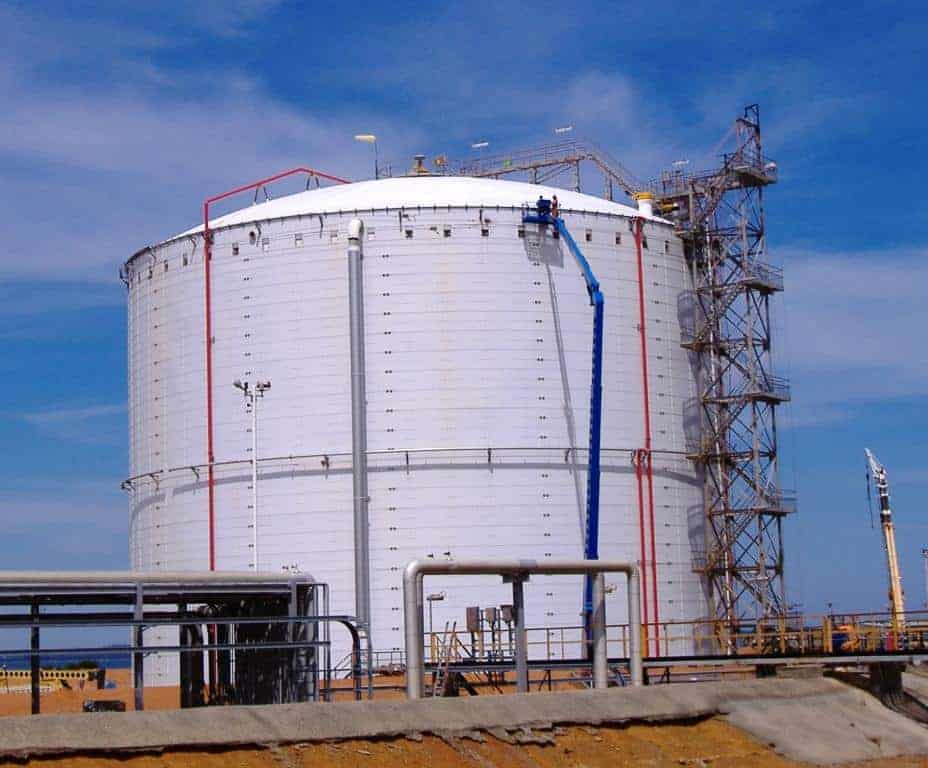
For large-diameter above-ground storage tanks, pre-engineered panel systems offer several structural and operational advantages that spray foam simply can’t match. The most significant is removability. A panel system can be taken apart, section by section, to allow full access to the tank wall for inspection or repair — and then reinstalled without starting over. For tanks that hold regulated substances or that are subject to routine inspection, this is not a minor convenience. It’s a meaningful operational advantage.
Panel systems are also engineered to accommodate thermal expansion and contraction. Industrial tanks expand and contract with temperature changes, and a rigid foam layer bonded directly to the surface can crack over time under that stress. Pre-engineered systems use tensioned banding assemblies and factory-curved panels that move with the tank rather than fighting it — which is why they tend to outlast field-applied spray foam in high-cycle thermal environments.
There’s also the question of what happens to the tank while the insulation is being installed. With a pre-engineered sidewall system that uses no welded attachments, the tank stays fully operational throughout installation. There’s no shutdown, no production loss, no gap in fire protection coverage. For a facility in Nassau County managing a fire suppression water tank or a fuel storage vessel that feeds active operations, that distinction has real dollar value.
The tradeoff is that panel systems are purpose-built for specific tank geometries. They require upfront engineering, precise measurement, and factory fabrication. That process takes time and investment. For a small retrofit on an oddly shaped vessel, spray foam may genuinely be the more practical choice. For a large, standard-geometry tank where long-term performance and maintenance access matter, a pre-engineered system is typically the stronger call.
Spray Foam Tank Application: Matching the Method to the Job
The mistake most facility managers make isn’t choosing the wrong product — it’s applying the right product to the wrong situation. Spray foam is an excellent tool. So are pre-engineered panel systems. The question is what your tank actually needs, and that depends on factors like tank size, contents, operating temperature range, regulatory requirements, and how often the tank wall needs to be accessed.
Spray foam tends to win on retrofit projects with irregular geometry, on smaller tanks where panel fabrication costs aren’t justified, and in situations where a seamless, fully bonded exterior barrier is the priority. Panel systems tend to win on large standard tanks, on applications with extreme temperature requirements, and wherever long-term maintenance access is part of the operational plan. Neither answer is universal — and the right contractor should be able to walk you through both options honestly.
What Does Corrosion Under Insulation (CUI) Mean for Your Tank?
Corrosion under insulation is the failure mode that doesn’t announce itself until it’s already done significant damage. It happens when moisture — from rain, condensation, or humidity — penetrates the insulation system and sits against the tank wall. In a coastal environment like Nassau County, where salt-laden air off the Atlantic and Long Island Sound accelerates corrosion on carbon steel, CUI isn’t a theoretical risk. It’s a documented operational reality that we see regularly in the field.
The insulation method you choose has a direct impact on CUI risk. Spray foam, when properly applied with closed-cell formulation and appropriate surface prep, creates a moisture-resistant layer that limits water intrusion. But if the foam cracks — from thermal cycling, impact, or improper application — water can enter through those cracks and become trapped against the tank wall, where it’s invisible and inaccessible. By the time you see the problem, you may already be dealing with structural compromise.
Pre-engineered panel systems with custom vapor barriers address this differently. The vapor barrier is designed as a distinct, engineered layer — not a byproduct of the foam’s cell structure — and the system can be opened for inspection if you suspect moisture infiltration. That inspectability is one of the primary reasons panel systems are preferred for high-value, long-service-life applications.
The honest answer is that no insulation method eliminates CUI risk entirely. What reduces it is quality materials, proper installation, and a system design that accounts for your specific environment. For Nassau County facilities dealing with coastal humidity and freeze-thaw cycles through the winter months, that environmental context should be part of the specification conversation from the start — not an afterthought.
Insulation Performance Comparison: Cost, Lifespan, and Long-Term Value
Upfront cost comparisons between spray foam and panel systems can be misleading if you stop at the installation invoice. Spray foam typically has higher per-square-foot material and labor costs than fiberglass blanket systems, but lower upfront cost than a fully engineered panel system on a large tank. That gap narrows — and often reverses — when you account for lifespan, maintenance requirements, and the cost of failure.
A well-installed pre-engineered panel system on a large industrial tank is designed to last decades with minimal maintenance. The exterior sheathing resists corrosion, the tensioned banding accommodates thermal movement without cracking, and the system can be inspected and repaired in sections rather than replaced wholesale. Spray foam systems, depending on the application environment, may require more frequent inspection for cracking or delamination — particularly in environments with significant thermal cycling or UV exposure.
There’s also the energy savings side of the equation. Properly insulated industrial storage tanks can reduce total operating costs by reducing the thermal load on refrigeration and heating systems. For a large facility, that’s a meaningful return — and the better the insulation system performs over time, the longer that return compounds. A system that degrades in year five and needs partial replacement hasn’t delivered the same value as one that performs consistently for twenty years.
For Nassau County facilities — whether you’re operating a fire protection water storage tank subject to NFPA 22 compliance requirements, a cold storage vessel at a food processing facility, or a petroleum storage tank along the South Shore — the long-term performance calculation should drive the decision more than the line item on the initial quote. The Nassau County Fire Marshal’s office enforces NFPA 22 actively, and an insulation system that fails inspection doesn’t just cost money to replace. It creates liability.
How to Choose the Right Tank Insulation Method for Your Facility
The short version: spray foam is a legitimate, high-performing option for the right applications — and so are pre-engineered panel systems. What separates a good outcome from a costly one is matching the method to the actual conditions of your tank, your environment, and your operational requirements.
For facilities in Nassau County, those conditions include coastal corrosion risk, cold winters that stress uninsulated systems, active regulatory enforcement, and in many cases, tanks that need to stay operational through whatever work is being done. Those aren’t abstract considerations — they’re the specific variables that should shape your specification.
If you’re working through this decision and want a straight answer about what method makes sense for your tank, we’ve been doing exactly this work since 1971. Reach out and let’s talk through it.