Summary:
If you’re managing a commercial or industrial facility, you’ve probably noticed that “insulation contractor” covers a lot of ground. Spray foam for attics, blown-in for walls, pipe wrapping, tank systems — it all falls under the same umbrella, but the expertise behind each is completely different. The challenge is that most contractors don’t advertise what they can’t do. So you end up comparing quotes without a clear picture of who’s actually qualified for your specific project. That gap matters a lot more when you’re dealing with industrial storage tanks, cold storage systems, or fire protection infrastructure than it does when you’re insulating a basement.
What "Specialized" Commercial Insulation Contractors Actually Do
There are roughly 28,000 insulation contractor businesses operating in the United States. The overwhelming majority serve residential and light commercial markets — attics, crawl spaces, building envelopes. That’s a legitimate and important service. But it has almost nothing in common with what industrial tank insulation requires.
We work in a completely different space: extreme operating temperatures, regulatory compliance standards, structural engineering considerations, and in many cases, the need to keep the system fully operational while work is being done. These aren’t details you can improvise on-site. They require pre-engineered systems, materials designed for the specific application, and a contractor who has spent years — ideally decades — working exclusively in this space.
Spray Foam Roofing Contractors vs. Tank Roofing System Specialists
This is one of the most common points of confusion for facility managers, and it’s worth addressing directly. Spray foam roofing contractors do important work — they apply spray polyurethane foam to commercial building rooftops to improve thermal performance and weatherproofing. It’s a specialized skill in its own right. But it has very little overlap with what a tank roofing system requires.
Storage tanks move. They expand and contract with temperature changes, shift under load, and behave structurally in ways that a standard commercial roof never does. A tank roofing system has to be engineered to accommodate that movement independently — it can’t just be fastened down like a building roof. The materials, the attachment methods, and the structural design are fundamentally different.
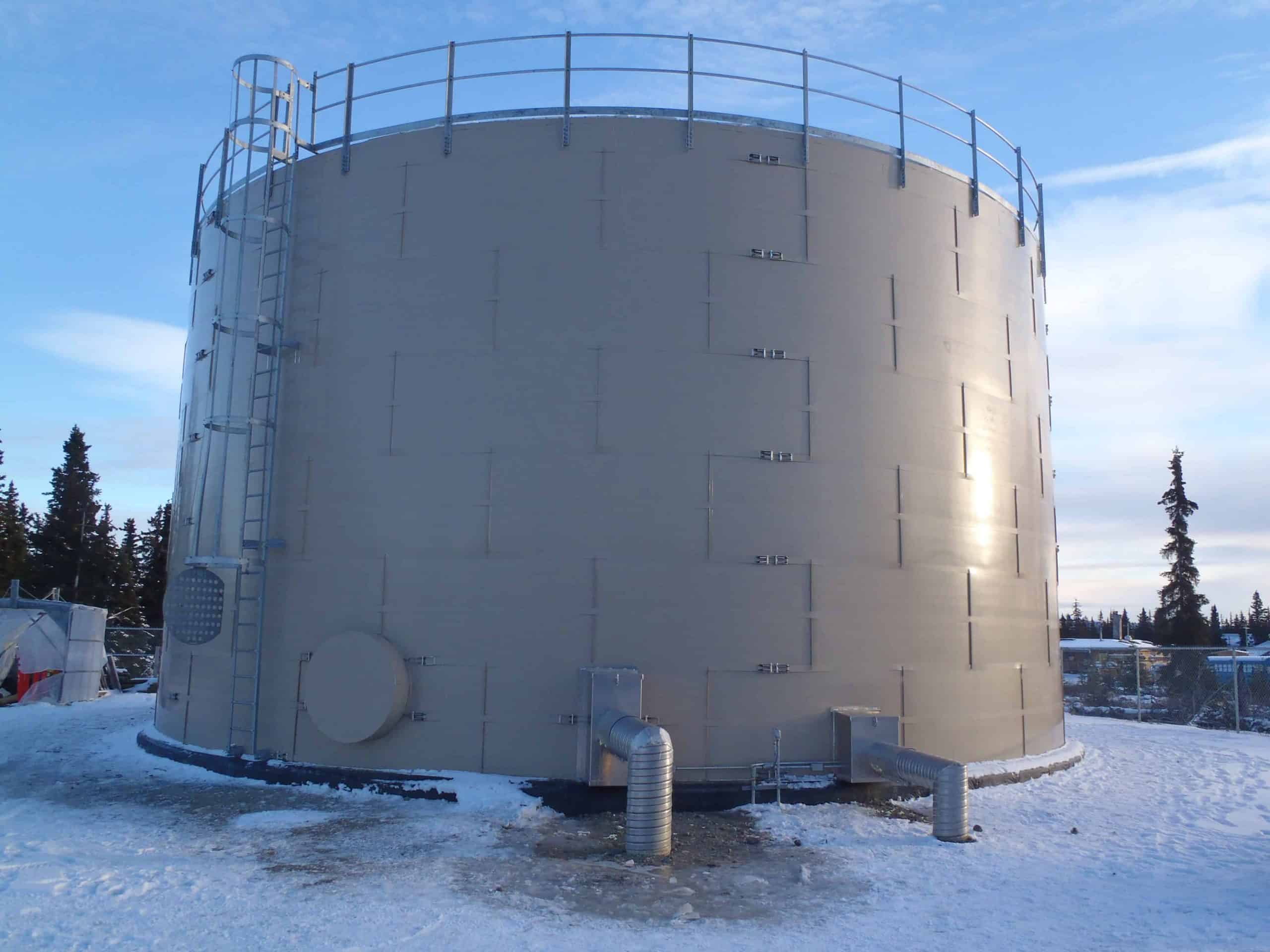
Our tank roofing systems are custom-engineered metal sheathing systems, designed specifically for each tank’s dimensions and operating environment. They’re not adapted from building roofing products. Every system we produce is pre-engineered to fit the exact tank it’s going on, and our roofing systems are rated to withstand wind speeds up to 150 mph. For coastal facilities, where Atlantic storms and nor’easters are a real operational risk, not a theoretical one, that wind rating isn’t a marketing figure. It’s an engineering requirement.
The cost difference between spray foam roofing and a custom tank roofing system is real, but so is the performance gap. SPF roofing on a standard 20,000 sq. ft. commercial roof runs roughly $5 to $10 per square foot. A custom-engineered tank roofing system involves a different scope entirely — site-specific structural analysis, precision fabrication, and installation that accounts for the tank’s live behavior. Comparing the two on price alone is like comparing a commercial HVAC system to a window unit.
Roof Insulation Contractors and the Industrial Tank Gap
Standard roof insulation contractors work on building envelopes — flat commercial rooftops, sloped residential roofs, and similar applications. They’re experienced with common insulation materials, weatherproofing membranes, and building code compliance for occupied structures. That’s a well-defined scope of work, and plenty of contractors do it well.
The problem arises when a facility manager assumes that experience translates to industrial tank applications. It doesn’t — and not because of any failure on the contractor’s part. It’s simply a different discipline. Industrial storage tanks aren’t buildings. They don’t follow the same structural logic, they don’t operate within the same temperature ranges, and they don’t carry the same regulatory requirements.
Consider what a tank insulation system actually needs to do. For a cold storage tank holding ammonia-based products, the system has to maintain temperatures as low as -50°F while managing condensation and vapor pressure from the outside in. For a petrochemical storage tank, the system has to perform reliably at high temperatures while preventing heat gain that could destabilize the product. For a fire protection water tank at a municipal or commercial facility, the system has to meet NFPA 22 standards — the National Fire Protection Association’s governing standard for water tanks used in private fire protection. None of these requirements show up in a standard commercial roofing project.
We’ve been engineering and installing tank insulation systems since 1971. That’s over 40 years of working exclusively in this space, refining systems for exactly these kinds of applications. We also manufacture our own insulation products — which means we control the material quality from the start, not just the installation. When a contractor sources materials from a third party, they’re trusting someone else’s quality control. We don’t operate that way.
Pipe Insulation Installers: What Commercial Facilities Need to Know
Mechanical pipe insulation is another area where the generalist-versus-specialist gap shows up in real, measurable ways. Commercial and industrial pipe systems — whether they’re carrying chilled water, steam, process chemicals, or fire suppression supply — lose energy continuously when they’re not properly insulated. That’s not a minor inefficiency. In regions where commercial energy rates are high, uninsulated or under-insulated pipe systems represent a significant ongoing cost.
Pipe insulation installers working in commercial and industrial settings operate under a specific set of standards: ASHRAE 90.1 sets minimum R-value requirements by climate zone, ASTM C533 governs calcium silicate insulation for high-temperature applications, and the MICA Manual — the North American Commercial and Industrial Insulation Standards — is the industry’s primary reference for installation technique. These aren’t guidelines that general contractors typically work from.
How Mechanical Pipe Insulation Works — and Why It's Not a DIY Decision
The basic function of pipe insulation is straightforward: reduce heat transfer between the pipe and its surrounding environment. But the execution is more involved than it looks. The right insulation material depends on the operating temperature of the pipe, the ambient conditions around it, whether vapor control is needed, and the specific regulatory requirements that apply to the facility and its use.
For a commercial facility running a chilled water system, the concern is usually condensation — warm, humid air hitting a cold pipe surface and forming moisture that can corrode the pipe, damage surrounding materials, and reduce system efficiency over time. The insulation system has to manage that vapor pressure correctly, which means the right material, the right thickness, and properly sealed joints. Get any one of those wrong and you’ve created a slow-moving maintenance problem.
For high-temperature process pipe systems — steam lines, industrial heating loops, applications approaching the upper limits of standard insulation materials — the stakes are different but equally significant. ASTM C533 calcium silicate insulation is rated for temperatures up to 1,200°F. That’s the kind of specification that comes into play in industrial and petrochemical settings, not in a standard commercial building. A general insulation contractor who doesn’t routinely work in these environments is unlikely to be familiar with it.
What this means practically: when you’re evaluating pipe insulation installers for a commercial or industrial project, the question isn’t just whether they’ve done pipe insulation before. It’s whether they’ve done it at the temperature range, system complexity, and compliance level your project requires. Those are different questions, and the answers will tell you a lot about who you’re actually dealing with.
FAQs: What Facility Managers Ask About Commercial Insulation Contractors
**Can the tank stay in operation while insulation is being installed?**
This is one of the first questions we hear from facility managers, and it’s the right one to ask. For most industrial operations, taking a storage tank offline isn’t just inconvenient — it’s costly, and in some cases, it creates its own regulatory and safety complications. Our pre-engineered sidewall systems use no welded attachments during installation, which means the tank remains fully operational throughout the entire process. That’s not a workaround — it’s how the system is designed. If a contractor can’t confirm this upfront, it’s worth pressing them on it before you sign anything.
**Does it matter if my facility is on the coast?**
It matters significantly. Industrial and municipal infrastructure along the Atlantic and Gulf coastlines faces real exposure to hurricane-force winds, salt air corrosion, and storm surge risk. Our tank roofing systems are engineered to withstand wind speeds up to 150 mph — a specification that’s directly relevant to facilities that fall within Atlantic and Gulf storm corridors. A standard commercial roofing product installed on an industrial tank in this environment is an engineering liability.
**What’s the difference between a commercial insulation contractor and a general contractor who offers insulation?**
A general contractor who offers insulation as one of many services knows enough to handle standard building applications. What they typically don’t have is deep familiarity with tank-specific materials, compliance documentation for NFPA 22 or ASTM standards, or experience designing systems for extreme temperature ranges. The gap shows up most clearly when something goes wrong — condensation forming inside a cold storage system, insulation degrading under high heat, or a roofing system failing in a storm. At that point, the cost of the original choice becomes very clear.
**What temperature ranges can industrial tank insulation systems handle?**
Our systems are engineered to perform from -50°F up to +500°F. That range covers ammonia cold storage at the low end and high-temperature petrochemical applications at the high end. Most general insulation contractors work with materials that perform well within a much narrower band — adequate for building envelopes, but not for the extremes that industrial storage tanks routinely operate at.
Choosing the Right Commercial Insulation Contractor for Industrial Applications
The distinction between a general commercial insulation contractor and a specialized industrial tank insulation provider isn’t about prestige — it’s about fit. For building envelopes, attics, and standard commercial spaces, a qualified general contractor does the job well. But for storage tanks, mechanical pipe systems, cold storage applications, and fire protection infrastructure, the requirements are different enough that the contractor category genuinely matters.
If you’re managing a facility — whether it’s a water treatment plant, a petrochemical distribution site, a food processing operation, or a commercial campus with fire suppression infrastructure — the insulation decisions you make affect energy costs, regulatory compliance, operational continuity, and long-term system integrity. Those aren’t areas where a lowest-bid generalist approach tends to hold up.
We’ve been working exclusively in tank insulation systems for over 40 years. If you’re trying to figure out whether your project calls for a specialist, we’re straightforward to talk to.