Summary:
Search “insulation services near me” and you’ll get pages of attic insulation contractors, spray foam companies, and home improvement marketplaces. That’s fine if you’re insulating a crawlspace. But if you’re managing an industrial storage tank in Nassau County, NY, that search result page is basically useless to you.
The real question isn’t which local contractor shows up first. It’s which tank insulation system — vertical or horizontal — is actually right for your specific tank, your product, and your operating environment. Those are two very different questions, and the answer to the second one has real consequences for your energy costs, your compliance standing, and your long-term maintenance bill.
Vertical Tank Systems: How They Work and Where They Excel
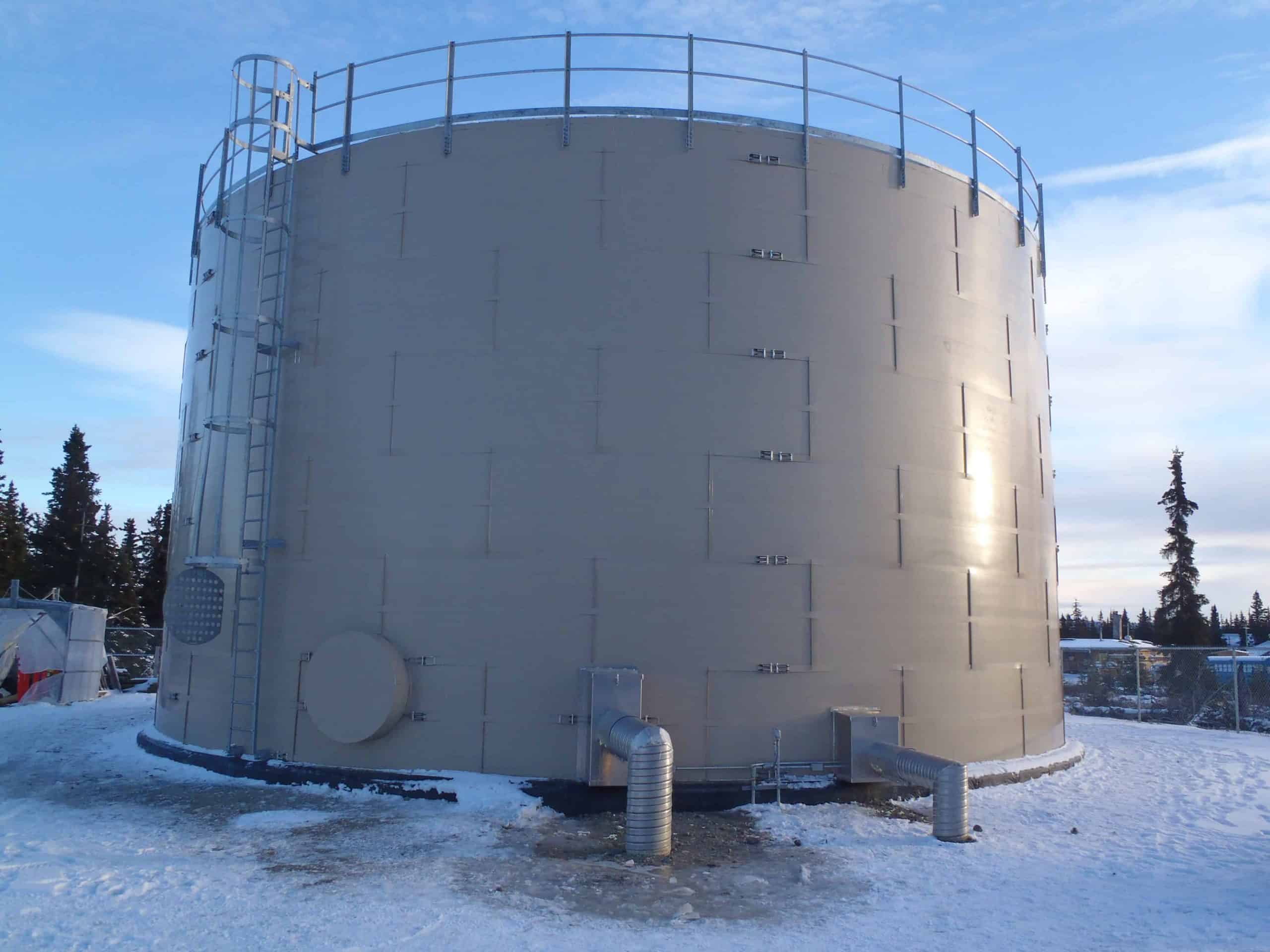
Vertical tank insulation uses pre-engineered standing seam panels — typically two feet wide, manufactured to the exact height of your tank — that run from the base to the top of the sidewall. The standing seams between panels aren’t just structural. They’re functional. They allow the entire system to expand and contract naturally as temperatures shift, which matters a great deal in Nassau County where you can go from a 15°F January night to a 90°F August afternoon within the same calendar year.
The outer shell is typically .024-inch aluminum, and the insulation core is polyisocyanurate foam — roughly 6.25 R-value per inch, which means even a few inches of material gets you well past the DOE’s baseline R-12.5 standard for industrial storage tanks. Single-piece panels can be manufactured up to 50 feet tall, which covers most storage tanks without requiring field splices that could become weak points over time.
Why Nassau County's Coastal Climate Puts Vertical Systems to the Test
Nassau County sits on the western end of Long Island, directly exposed to Atlantic weather systems. Nor’easters, sustained coastal winds, and the occasional tropical storm remnant are not rare events here — they’re part of operating in this market. That environmental reality has direct implications for how your tank insulation system needs to be built.
Vertical standing seam panels handle wind loading well because the seam design distributes lateral force across the full height of the panel rather than concentrating it at connection points. Our tank roofing systems are engineered to withstand wind speeds up to 150 mph, which isn’t an over-engineered specification for a coastal Nassau County facility — it’s an appropriately specified one.
Salt air is the other factor that rarely gets discussed in generic insulation comparisons. Nassau County’s proximity to the ocean means elevated salt content in the ambient air year-round. That accelerates corrosion on any metal component that isn’t properly specified for coastal exposure. Our systems use corrosion-resistant exterior sheathing designed to hold up in exactly these conditions. It’s not a premium add-on — for a facility operating anywhere near the Long Island Sound or the Atlantic coast, it’s a baseline requirement.
There’s also the freeze-thaw cycle to consider. Nassau County winters bring repeated cycles of freezing and thawing, particularly in late winter and early spring. For fire protection water storage tanks — which must comply with NFPA 22 standards — this is a non-negotiable insulation trigger. A tank that freezes during an overnight cold snap isn’t just an operational problem. It’s a liability. Vertical systems with proper vapor barriers and continuous panel coverage give you the thermal consistency to prevent that scenario.
One more thing worth noting: we install our sidewall systems without welded attachments. That means your tank stays fully operational throughout the entire installation process. For a facility that can’t afford a production shutdown — and most can’t — that’s not a minor convenience. It’s a fundamental part of how we work.
What Vertical Tank Insulation Actually Costs You — and Saves You
Cost comparisons between vertical and horizontal systems tend to focus on the upfront installation number, which misses most of the actual financial picture. The more useful question is: what does each system cost you over its operational life?
Vertical panels are generally faster to install than horizontal systems. Horizontal installation typically requires scaffolding, a hydraulic lift large enough to hold two workers plus 8-foot panels, or elaborate hanging scaffolding. Vertical panels go up more efficiently, which reduces labor hours and shortens the installation window — both of which affect your total project cost.
On the energy side, a properly specified vertical system can deliver R-values well above the DOE baseline, reducing heat transfer significantly. For a petrochemical storage facility, that translates directly to lower evaporation losses. Facilities storing gasoline, kerosene, or similar light fractions can lose hundreds of thousands of gallons annually to evaporation without adequate insulation — at current market prices, that’s a cost that dwarfs the price of a quality insulation system. The ROI timeline in those applications is often less than a year.
For cold storage tanks — particularly those storing ammonia or butane, which are common in industrial applications across Nassau County — the energy savings from reduced cooling system workload are compounded over time. Our systems are engineered to maintain consistent temperatures as low as -50°F, which means the cooling equipment isn’t working harder than it needs to. That’s a real, measurable reduction in operating costs that shows up every month on your utility bill.
The longer-term cost factor is maintenance. Vertical systems don’t rely on banding or tensioned components that can loosen or fail over time. The standing seam design is inherently stable, and because the panels accommodate thermal movement naturally, you’re less likely to see the gap formation and moisture intrusion that drives up maintenance costs in systems that weren’t designed with movement in mind.
Horizontal Tank Insulation: When It Makes Sense and When It Doesn't
Horizontal tank insulation uses factory-curved panels that wrap around the circumference of the tank, held in place by tensioned aluminum banding. The panels are pre-curved to match the tank’s radius, and springs built into the external bands allow the system to accommodate thermal expansion and contraction — a different mechanical approach to the same problem that vertical seams solve structurally.
There are applications where horizontal systems are a reasonable fit, particularly on tanks with specific geometric requirements or where the project calls for a particular aesthetic. But horizontal systems come with trade-offs that are worth understanding clearly before you commit to one.
The Delamination Problem: What Happens When Horizontal Panels Fail
The most significant long-term risk with horizontal panel systems is delamination — the process by which the polyisocyanurate foam core separates from the aluminum outer shell. When that happens, the panels shift. And when panels shift, gaps open in the insulation envelope.
Those gaps are moisture intrusion points. In Nassau County’s humid coastal climate, that’s not a theoretical concern — it’s a predictable failure mode. Once moisture gets behind the insulation, you’re looking at corrosion under insulation, or CUI, which is one of the most expensive failure scenarios in industrial tank operations. CUI develops slowly and often isn’t visible until the damage is already significant. By the time you see evidence of it on the outside, you may be looking at a major structural repair, not just an insulation replacement.
Wind makes the problem worse. In a market with Nassau County’s wind exposure, gaps that open from delamination don’t stay small. Sustained coastal winds catch those gaps and progressively widen them, accelerating both the insulation failure and the underlying corrosion. A horizontal system that looked fine after installation can deteriorate faster than expected in a coastal environment — and the maintenance costs that follow tend to exceed what a better-specified system would have cost upfront.
This isn’t an argument that horizontal systems are never appropriate. It’s an argument that the environment matters enormously in this decision, and that a system which performs adequately in a sheltered inland location may not be the right choice for a facility operating on Long Island.
Tank Configuration Comparison: How to Think Through the Decision
The vertical versus horizontal question doesn’t have a universal answer, but it does have a structured way of thinking through it. Here’s how we approach it with clients.
Start with what you’re storing and at what temperature. For cold storage tanks operating at cryogenic or near-cryogenic temperatures — ammonia at -50°F, for example — the vapor barrier becomes the most critical component in the system. Any gap in the insulation envelope allows moisture to migrate toward the cold surface, where it freezes and progressively damages the system from the inside. In those applications, the continuous coverage and natural seam movement of a vertical system typically outperforms a horizontal configuration.
For petrochemical tanks, the primary concern is solar heat gain and evaporation. Here, the R-value of the insulation core and the integrity of the outer shell are the key performance variables. Both vertical and horizontal systems can achieve adequate R-values, but the long-term integrity of the outer shell — its resistance to delamination, wind damage, and corrosion — often tips the decision toward vertical in coastal markets.
For fire protection water storage tanks subject to NFPA 22, the freeze protection requirement is the governing factor. Nassau County’s winters are cold enough that an uninsulated or under-insulated fire protection tank is a genuine risk. The insulation system needs to maintain water temperature above freezing through the coldest nights of the year, which in Nassau County can mean sustained temperatures in the single digits during a nor’easter. That’s a performance requirement that needs to be engineered, not estimated.
The installation method also affects the decision. If your facility cannot tolerate a shutdown — and most industrial operators on Long Island can’t — the no-welded-attachment installation approach is a requirement, not a preference. Both vertical and horizontal systems can be installed without welding, but the logistics differ, and the project timeline for each configuration varies based on tank diameter, height, and site access. These are all variables that belong in an engineering conversation before you sign anything.
The right answer for your facility in Nassau County, NY may be different from the right answer for a similar facility in a different climate, and it’s worth getting that evaluation done properly.
Finding the Right Industrial Insulation Services Near You in Nassau County, NY
If you’ve been searching for insulation services near me and finding nothing but residential contractors, you’re not imagining the gap. Industrial tank insulation is a specialized discipline, and most of the search results simply aren’t built for the kind of decision you’re making.
The vertical versus horizontal question is a real one, and it deserves a real answer — one that accounts for your tank type, your product, your operating temperatures, Nassau County’s coastal climate, and the regulatory requirements that apply to your specific application. Getting that answer right upfront saves you from maintenance costs, compliance problems, and energy waste that compound over years of operation.
We’ve been doing this work since 1971. If you’re managing a storage tank on Long Island and you want a straight conversation about which system makes sense for your situation, reach out to us. No pitch, no pressure — just an honest engineering evaluation from a team that has been doing exactly this kind of work for over four decades.